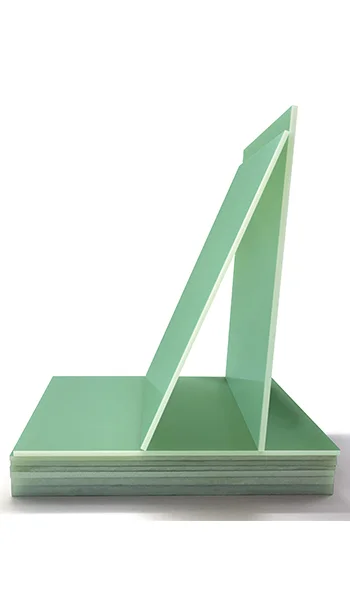
“I Don’t Want These Offcuts—Why Do I Have to Pay for Them?”
The Hidden Size Trap Behind a 6,000 kg Custom-Cut 3240 Order
Reader note The buyer and company are anonymized. The dialogue and sequence have been reconstructed from common project communications to protect commercial privacy. The images are recreated editorial scenes, not identifiable customer photographs. Any real customer messages or images are published only after explicit permission.
The quote looked simple—until one dimension changed everything
The inquiry arrived in four tidy lines: 3240 epoxy glass cloth laminate, 25 mm thick, 950 x 1850 mm finished size, approximately 6,000 kg. The buyer, a Russian manufacturer machining industrial electrical components, wanted a direct price and a short lead time. On paper, it looked ready to quote.
Then production checked the size. The requested 950 x 1850 mm was not a standard parent sheet; it had to be cut from a larger laminate. That small difference changed the material yield, sheet count, handling plan and, ultimately, the price.
We proposed cutting it from 1020 x 2020 mm sheets, the closest practical format. The cut was straightforward. The harder part was explaining why the narrow strips removed from all four sides could not simply disappear from the cost.
The buyer asked the question at the heart of the order: “I don’t want these offcuts—why do I have to pay for them?”

A custom size begins with the parent sheet
3240 is made by impregnating electrical-grade glass cloth with epoxy resin, drying the material and consolidating the layers under heat and pressure. A thick panel is therefore produced as a complete laminate before it is trimmed to a smaller rectangle. We cannot pour or press only the final outline as if it were a molded plastic part.
For this order, a 1020 x 2020 x 25 mm parent sheet was the closer production format. The requested 950 x 1850 mm panel uses about 85.3% of its area. The remaining material becomes trim unless the buyer has a use for the offcuts and agrees in advance to receive them.
A larger 1200 x 2400 mm parent sheet might sound more flexible, but the requested rectangle would use only about 61% of that area. It would create more unused material, add handling weight and make the quotation less efficient. The right answer was not simply ‘yes, we can cut it.’ It was to select the closest practical parent sheet before confirming the price.
When we sent the cutting layout, the buyer understood the difference immediately. He was not being charged for empty space. The quote reflected the glass cloth, resin, pressing time and energy used to make the whole parent sheet, followed by the cutting needed to reach his final size.

| Item | Nominal calculation | Planning result |
|---|---|---|
| Finished sheet | 950 x 1850 x 25 mm | Approx. 92.3 kg |
| Order plan | 65 finished sheets | Approx. 6,000 kg |
| Area use | 1020 x 2020 mm parent | Approx. 85.3% |
The weight turned a sheet order into a handling plan
We then calculated the finished-sheet weight using the agreed nominal density of 2.1 g/cm3. One 950 x 1850 x 25 mm panel comes to approximately 92.3 kg. About 65 finished panels would therefore be close to 6,000 kg.
That number changed the conversation again. A 25 mm panel is not a thin sheet that two people should casually carry across a workshop. The buyer needed to know how many panels would arrive, how they would be separated, how the pallet would be reinforced and whether his warehouse had suitable lifting equipment.
We also explained that 6,000 kg and 65 sheets are planning figures, not two independent guarantees. Actual shipment weight can move slightly with the agreed density range, thickness tolerance, trimming and packing. The purchase order should therefore state which quantity controls the order: an exact number of sheets, a target net weight, or an agreed tolerance around both.
The buyer chose to confirm the order by sheet count and use the calculated weight for logistics planning. That prevented a familiar problem: receiving the right tonnage but the wrong number of machinable blanks.
The final part mattered more than the yellow surface
Until this point, we had discussed the product as a rectangular panel. Then we asked for the part drawing. The buyer planned to machine thick insulation supports with holes close to several edges. His real concern was not whether the full sheet looked smooth in a photograph. It was whether the machined edges and holes would remain usable after cutting and drilling.
That changed the inspection plan. We agreed to check thickness at several positions, inspect representative cut edges and review the machining layout before packing. If a customer is making structural insulation parts, the material, cutter condition, feed, support and dust extraction all affect the result. A polished face alone cannot answer those questions.
The buyer had also requested ‘3240 A.’ We treated that phrase as the beginning of a specification, not the end of one. Commercial A and B labels can vary between suppliers and markets; they should not replace a written technical agreement. We therefore confirmed the resin and glass-cloth laminate type, nominal density, thickness and size tolerances, intended use, inspection points and sample expectations in the quotation.
This protected both sides. The buyer did not have to rely on a grade name that might mean something different in another factory, and production did not have to guess what his machining shop considered acceptable.
Packaging became part of product quality
The last issue appeared after the material plan had been approved. If each finished panel weighed about 92.3 kg, a pallet could not be designed only to look tidy in a loading photograph.
We divided the sheets into reinforced pallet loads, placed protective material between contact surfaces, added corner protection and controlled the strap positions so they would secure the stack without damaging the edges. Pallet weight and forklift access were checked before dispatch. The buyer used the same information to prepare unloading space at his warehouse.
This solved a pain point that is often discovered too late. A panel can leave production within specification and still arrive with chipped corners or stressed edges if the package is designed like a bundle of thin sheets. For thick 3240, handling is part of the supply plan, not an afterthought.

The quotation changed because the problem became clearer
The buyer originally wanted one number: the price for 6,000 kg. What he finally received was a workable order definition: approximately 65 cut panels, produced from the closer parent-sheet format, inspected for the intended machining route and packed according to their real unit weight.
Nothing dramatic happened. There was no miraculous material and no promise that one grade could suit every application. The order moved forward because each question revealed the next decision that had to be made.
If you are purchasing custom-cut 3240, send more than thickness and total kilograms. Include the finished size, required sheet count, part drawing or machining method, tolerance, acceptable offcut arrangement, inspection needs and unloading conditions. Those details do not make an inquiry complicated. They are what turn a price into a supply plan that can actually work.
The most useful question is not only, ‘Can you cut this size?’ It is, ‘What must happen before and after the cut so that the material still works for my parts?’