Information Details
Youda insulation material manufacturer regularly updates insulation product information and company news to keep you informed of the latest developments and industry trends.
Technical Data of Bakelite Sheet: Properties and Standards
In modern industrial design, Bakelite Sheet remains a cornerstone material for precision components, insulation systems, and mechanical structures. Although it was among the earliest synthetic plastics, its technical characteristics continue to outperform many modern composites in specific engineering contexts. Understanding the technical data of Bakelite Sheet is essential not only for material selection but also for ensuring compliance with industrial standards that demand both performance and consistency.
This article explores the material composition, mechanical and electrical properties, dimensional stability, and standard classifications of Bakelite Sheet—delving deeper into how these parameters influence its real-world functionality.

1. Composition and Structure of Bakelite Sheet
At its core, Bakelite Sheet is a phenolic resin laminate, created through the polymerization of phenol and formaldehyde under controlled heat and pressure. The base substrate—typically paper, cotton fabric, or glass cloth—is impregnated with phenolic resin, layered, and compressed to form a rigid thermoset composite.
The result is a sheet with excellent dimensional stability, hardness, and resistance to thermal deformation. Unlike thermoplastics, Bakelite Sheet does not melt; instead, it retains structural integrity under heat exposure, which makes it ideal for insulation and mechanical applications.
Key compositional aspects include:
Resin Type: Phenol-formaldehyde thermoset
Reinforcement: Paper, cotton, or glass fiber layers
Curing Mechanism: Heat-induced cross-linking reaction
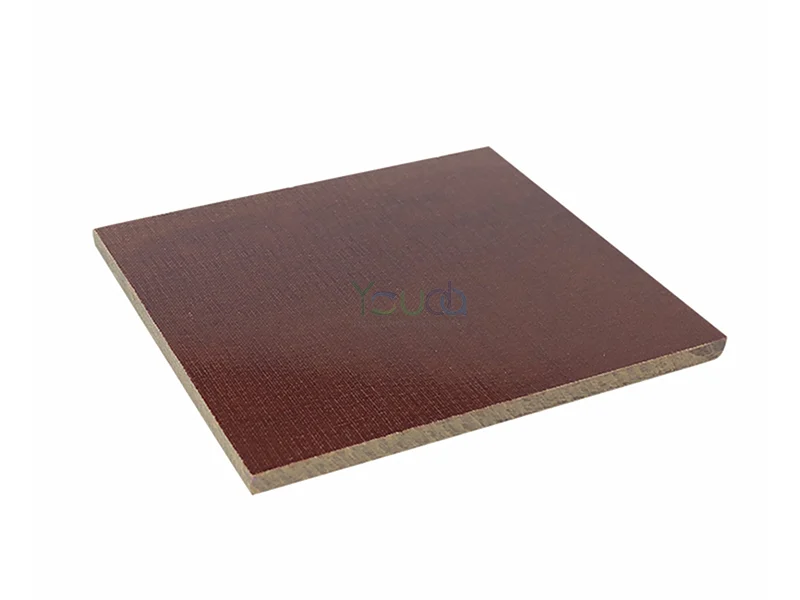
Surface Finish: Smooth or textured, depending on the press plate pattern
The reinforcement type defines much of the technical performance—paper-based Bakelite Sheets offer electrical insulation benefits, while cotton or glass-based sheets emphasize mechanical strength and wear resistance.
2. Mechanical Properties
One of the defining features of Bakelite Sheet is its mechanical stability under stress. Its rigidity, compressive strength, and wear performance make it particularly valuable for structural and mechanical components.
Typical Mechanical Parameters:
| Property | Unit | Typical Value (Paper-based) | Typical Value (Fabric-based) |
|---|---|---|---|
| Tensile Strength | MPa | 80 – 120 | 120 – 150 |
| Flexural Strength | MPa | 120 – 180 | 150 – 200 |
| Compressive Strength | MPa | 200 – 250 | 250 – 300 |
| Impact Strength (Charpy) | kJ/m² | 4 – 8 | 10 – 15 |
| Hardness (Rockwell M) | – | 100 – 110 | 105 – 115 |
The material’s cross-linked molecular structure gives it outstanding hardness and rigidity, while the fiber reinforcement enhances toughness and fatigue resistance. Fabric-based Bakelite Sheet, in particular, combines rigidity with machinability, making it suitable for gears, spacers, bearings, and jigs where dimensional accuracy is crucial.
3. Electrical and Thermal Properties
Originally developed as an electrical insulator, Bakelite Sheet maintains superior dielectric performance. Its low moisture absorption and high dielectric strength make it reliable in humid or high-voltage environments.
Electrical Performance Data:
| Property | Unit | Typical Value |
|---|---|---|
| Dielectric Strength | kV/mm | 9 – 12 |
| Volume Resistivity | Ω·cm | 10¹² – 10¹⁴ |
| Surface Resistivity | Ω | 10¹¹ – 10¹³ |
| Arc Resistance | sec | 100 – 180 |
Its thermal properties are equally noteworthy. Bakelite Sheet performs consistently across a wide temperature range without distortion, making it suitable for environments where heat dissipation and insulation coexist.
Thermal Characteristics:
| Property | Unit | Typical Value |
|---|---|---|
| Continuous Operating Temperature | °C | 130 – 150 |
| Short-Term Peak Temperature | °C | 180 |
| Coefficient of Thermal Expansion | ×10⁻⁶/°C | 20 – 30 |
| Thermal Conductivity | W/m·K | 0.25 – 0.3 |
This balance of electrical insulation and thermal resistance ensures the sheet’s reliability in transformer bases, switchgear panels, and motor housings, where both electrical and thermal factors are critical.
4. Dimensional Stability and Machinability
A critical factor often overlooked in material selection is dimensional stability—the ability of a material to maintain precise geometry under changing mechanical or environmental conditions.
Bakelite Sheet exhibits low moisture absorption (<0.5%), minimal creep under load, and excellent machinability with conventional tools. This makes it favorable for tight-tolerance machining, where deviations can affect assembly performance.
Precision cutting, drilling, and milling can be performed without delamination or surface degradation when proper feed rates and sharp carbide tools are used. Moreover, its low thermal expansion coefficient ensures dimensional consistency even under fluctuating temperatures.
5. Chemical Resistance and Aging Behavior
From a chemical standpoint, Bakelite Sheet offers remarkable resistance to many organic solvents, oils, and weak acids. The phenolic structure inherently resists oxidation and chemical degradation.
However, prolonged exposure to strong alkalis or oxidizing acids may cause surface embrittlement. This selective chemical resistance defines its best-use scenarios—ideal for mechanical, electrical, and industrial insulation, but not for continuous chemical immersion applications.
In terms of aging, Bakelite Sheet exhibits slow degradation kinetics. Its UV resistance, while moderate, can be improved through surface coatings or pigmentation. Long-term dimensional and mechanical stability under static load further enhances its reputation for durability in service environments.
6. Standards and Classification
Bakelite Sheet production follows several global standards that regulate its composition, performance, and quality control. Although local specifications vary, most manufacturers conform to IEC, NEMA, and ASTM classifications to ensure international interchangeability.
Common Standards:
| Standard | Classification | Description |
|---|---|---|
| NEMA LI-1 | Grades X, XX, XXX (paper) / C, CE, L, LE (fabric) | U.S. laminate standards defining electrical and mechanical properties |
| IEC 60893 | PFCP, PFCC, PFGB types | Defines phenolic laminate sheets based on reinforcement type |
| ASTM D709 | Phenolic Resin Sheet Specifications | Governs dimensions, tolerance, and mechanical properties |
| GB/T 1303 | Chinese national standard for phenolic laminates | Aligns with IEC standards for cross-market compatibility |
These standards provide consistency in dielectric strength, mechanical modulus, and moisture performance, ensuring that Bakelite Sheets from different suppliers perform uniformly under comparable conditions.
7. Focus Insight: The Role of Resin Cross-Link Density
While many discussions on Bakelite Sheet focus on its mechanical or electrical properties, a defining technical factor—resin cross-link density—is often underappreciated. This microstructural characteristic directly influences hardness, thermal endurance, and chemical resistance.
A higher cross-link density means tighter molecular networks, resulting in:
Greater heat distortion resistance
Improved solvent resistance
Reduced water absorption
Enhanced dimensional stability
However, excessively high cross-linking can reduce machinability and increase brittleness. Manufacturers thus optimize resin formulation and curing cycles to balance rigidity with processability, depending on end-use applications.
This precise engineering control separates high-performance Bakelite Sheets from generic phenolic laminates, a distinction especially relevant in aerospace fixtures, precision jigs, and insulation boards for high-voltage applications.
8. Applications Driven by Technical Standards
Due to its predictable technical performance, Bakelite Sheet finds use across industries that demand consistency and reliability. Typical applications include:
Electrical engineering: terminal boards, switch panels, arc shields
Mechanical engineering: bearing cages, gear blanks, wear plates
Tooling and fixturing: jigs, templates, workholding systems
Automotive and transport: brake components, insulator plates, spacers
Aerospace: precision bushings and insulating mounts
Each application leverages a specific property set—whether it be dielectric strength, thermal endurance, or machinability—governed by technical standards that define allowable tolerances and material behavior.
9. Sustainability and Modern Adaptation
In the context of modern material engineering, Bakelite Sheet continues to evolve. Although phenolic resin is a thermoset and not easily recyclable, recent innovations in resin synthesis and fiber reinforcement aim to reduce environmental impact while retaining technical performance.
Manufacturers are developing low-formaldehyde phenolic resins, improving safety and sustainability without compromising the characteristic hardness and dielectric strength of Bakelite Sheet. Furthermore, precision control in curing processes ensures energy-efficient production with reduced material waste.
This blend of heritage material science and modern manufacturing precision allows Bakelite Sheet to maintain relevance in an era dominated by advanced polymers and composites.
10. Conclusion
The technical data of Bakelite Sheet underscores why this century-old material remains indispensable in modern engineering. Its unique combination of electrical insulation, mechanical stability, and heat resistance continues to set benchmarks for thermoset laminates.
Beyond the surface-level specifications, the resin cross-link density and reinforcement composition dictate its true performance potential. By adhering to international standards such as NEMA, IEC, and ASTM, Bakelite Sheet delivers predictable, reproducible quality that engineers can rely on.
For professionals seeking materials that offer precision, durability, and compliance, Bakelite Sheet remains an enduring choice—rooted in classic chemistry but refined through modern technical mastery.
★★★ Recommended Reading:
The History of Bakelite Sheet: From Invention to Industry Standard
If you need detailed information about related products, you can let me know via online chat, email, WhatsApp, or any other method, and we will contact you on the same day to solve your problem.