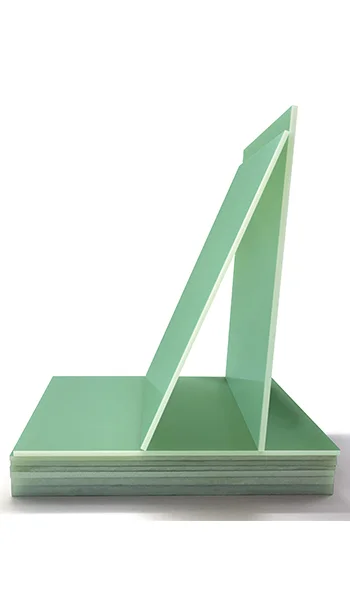
Both Were Green FR4 So Why Did This Batch Turn White at the Edges After Machining
The customer suspected a material substitution but the answer required checking the laminate and the cutting process together
Reader note The buyer and company are anonymized. The project sequence is reconstructed from common custom FR4 machining work. The images are editorial recreations.
The surface color matched but the machined edge did not
An overseas equipment manufacturer had purchased pale green FR4 custom parts from us before. The previous batch produced a compact green cut edge after routing. When the new batch reached the customer’s CNC shop, the sheet face looked almost identical, but the perimeter became noticeably pale after machining.
The customer’s first message was direct: Had we changed the material? Photographs seemed to support the suspicion. One retained part had a dense green edge, while the newly cut part showed a dry white line and more visible fibers. Both invoices said FR4 and both sheet surfaces were green.
We did not answer by comparing color cards. Green is a visual identifier, not a complete material specification. Two FR4 sheets can look close on the face while using different glass-cloth constructions, resin distributions or cure conditions. The same sheet can also produce different edges under different tools and cutting parameters.

A white edge is usually exposed glass or cutting damage not a new paint color
FR4 is a glass-cloth and epoxy laminate. The face color is largely seen through the resin system, but a machined edge exposes the internal cloth and resin together. If cutting pulls, crushes or rubs the glass fibers instead of shearing the laminate cleanly, light scatters from the damaged fibers and the edge appears white.
That appearance may be influenced by the laminate. A glass-rich local structure or less uniform resin wet-out can make fibers easier to expose. Cure condition also changes how the resin supports the cloth during cutting. However, an edge photograph alone cannot prove a resin or curing problem.
Tool wear can produce a nearly identical symptom. A dull cutter rubs before it cuts, creating heat and fiber pullout. Excessive spindle speed with insufficient feed may polish and heat the edge; aggressive feed, deep passes or poor support can cause breakout. Dust extraction also matters because recutting abrasive debris quickly damages the tool and roughens the edge.
We compared the process before judging the batch
We asked for the customer’s cutter type, diameter, flute count, spindle speed, feed rate, depth per pass, cutting direction, clamping method and tool-use history. The customer initially felt this was unnecessary because the previous batch had run on the same machine. But the machine name was not the process: the cutter had already completed other abrasive composite work, and the new program used a slower feed to protect a narrow section.
That slower feed increased rubbing time. At the same time, the new drawing required several tight internal corners, so the tool remained engaged longer. These conditions could amplify a small difference in laminate response and make the new batch look much worse than the old one.

| Check | What may change | Typical edge effect | How to verify |
|---|---|---|---|
| Laminate structure | Glass-cloth style and resin distribution | More glass exposed at the cut | Compare cross sections and retained samples |
| Cure condition | Hardness and resin response to cutting | Brittle or smeared edge behavior | Review batch records and machine coupons |
| Tool condition | Sharpness, geometry and runout | Fiber pullout, heat or rubbing marks | Use a known sharp tool and inspect wear |
| Cutting parameters | Spindle speed, feed and depth per pass | White abrasion line or rough edge | Run a small parameter matrix |
| Part support | Clamping and exit-edge stability | Local breakout or whitening | Repeat with stable backing and extraction |
* Edge color alone cannot determine material grade or final performance; acceptance must follow the agreed specification and test scope.
The useful answer came from four controlled cuts
We sent coupons from the production batch and kept matching coupons in our workshop. Rather than making one random cut, we used a small trial matrix: the customer’s existing tool and settings, a new cutter with the same settings, the new cutter with a balanced feed, and the balanced setting with a shallower finishing pass.
The worn cutter reproduced the pale fibrous edge. Replacing it removed most of the whitening. Adjusting feed and the finishing pass produced a compact edge close to the customer’s approved reference. This showed that the visible complaint was mainly process-sensitive, while the batch still required normal dimensional and specification checks before approval.
We did not claim that every white edge can be solved by changing speed. If controlled trials remain poor with a known sharp tool, the investigation must return to laminate structure, resin distribution, cure records and agreed performance tests. The point is to separate material evidence from machining evidence.
We supplied a machining window instead of one magic number
A single spindle-speed recommendation would not transfer reliably between machines. Cutter diameter, flute geometry, runout, rigidity, dust removal and part shape all affect the result. We therefore recorded an approved tool type, a practical feed-and-speed range, maximum pass depth, cutting direction and the visual edge standard from the trial.
The customer used that record for the replacement production run. Before the full quantity was released, one custom part was machined on the customer’s actual cutter setup and compared with the approved coupon. Only after the edge, dimensions and hole quality were accepted did batch machining continue.

Matching the color is not the same as matching the machining result
The customer had not received a secretly substituted color. The more useful conclusion was that FR4 edge appearance comes from the interaction between laminate construction and machining conditions. Surface color can screen incoming material, but it cannot replace a controlled cutting trial.
We can supply aqua-green FR4 in full sheets, custom-size blanks or finished parts. Processing can include precision cutting, drilling, routing, slotting, countersinking, threaded inserts and CNC machining. For parts with strict edge appearance, we can provide batch coupons or run a first article using the customer’s actual or equivalent tool geometry before volume production.
When changing a supplier, sheet thickness, part geometry or CNC program, keep one approved sample and record the tool condition and cutting parameters. That reference is far more useful than asking whether two green sheets look the same under office lighting.
这是示例文本,单击 “编辑” 按钮更改此文本。